
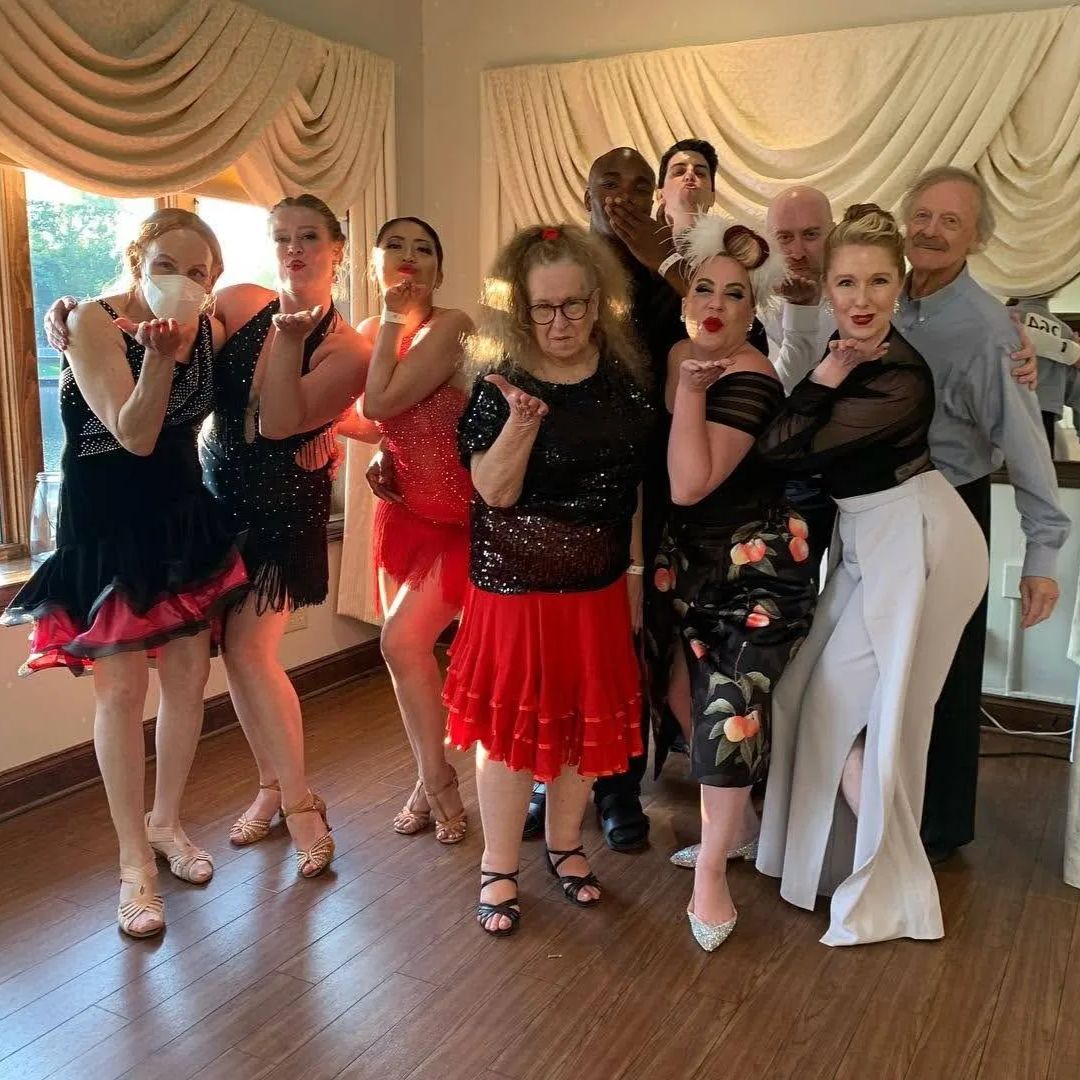
The benefits of dancing for adults are backed by real research, not just good vibes, and you don’t need any experience to start. It’s good for your body, your brain, and your mood.
At Concierge Ballroom, we teach people who’ve never danced before, so we get asked about this a lot. Here are six benefits worth knowing, each one backed by actual research.
1. Full-Body Workout That Doesn’t Feel Like One
Dancing raises your heart rate, works your legs and core, and builds cardio fitness. It does what a gym session does, minus the treadmill boredom. Because you’re focused on the music, you often work harder without noticing. That’s why so many people who “hate cardio” happily dance for an hour.
For the biggest workout, lean toward the faster styles. Salsa, with its quick footwork and constant spins, keeps your heart rate up the whole class.
2. Sharpens Your Brain
A landmark New England Journal of Medicine study followed older adults for years and found that frequent dancing was associated with a 76% lower risk of dementia.
The reason, according to Harvard Medical School: it pairs movement with mental effort. That fires up the brain’s motor and sensory circuits at once, and helps build new neural connections in the regions tied to memory. Steady, repetitive exercise just doesn’t do that.
3. Lifts Your Mood
Another thing we often don’t think about is how it triggers the release of endorphins and other feel-good brain chemicals, and the evidence goes further than that. A 2024 meta-analysis in Sports Medicine pooled 27 studies and nearly 1,400 people. It has been found that dance is just as effective as other types of exercise in alleviating depression and anxiety, and sometimes even better for motivation.
Add music you love and a room full of people enjoying themselves, and it’s one of the best mood boosters.
4. Improves Balance and Coordination
Balance and coordination are skills your nervous system builds through practice, and dancing is constant practice. Every step shifts your weight from one foot to the other, through turns, pauses, and quick changes of direction. Controlling those shifts over and over strengthens the small stabilizing muscles and sharpens your proprioception, your body’s sense of where it is in space.
Coordination improves for a related reason. You’re managing several things at once: your feet, your timing to the music, where you’re moving, and in partner dancing, another person too. The more you juggle them, the tighter the connection between your brain and your body gets.
This matters more with age, when staying steady and mobile matters most.
5. Connects You With People
Most workouts are solo affairs: headphones in, eyes down. Partner dancing is the opposite, since you literally can’t do it alone. That makes it one of the easiest ways to meet people as an adult. The dance community gives you a reason to connect, so there’s none of the pressure of cold small talk.
Not ready to walk into a room of strangers? You can start with private lessons to build the fundamentals, and if you wish, you can also join group classes and social nights. At our dance studio in Philadelphia, students rotate partners in group classes. That way, they can meet people and try real-life social dancing.
6. Builds Confidence
Partner dancing is a great way to become more comfortable around other people, which can build confidence over time. You’re learning to move with someone you may have just met, communicate without saying much, and stay relaxed even when you don’t get every step right. As you become more comfortable making mistakes and trying again, you may feel less self-conscious in social situations.
And perhaps the biggest benefit? Instead of sitting on the sidelines at a wedding, party, or social event, you can feel confident stepping onto the dance floor and enjoying yourself.
Which Dance Is Best for Each Benefit?
No single style does everything, but some are especially good at certain things. If you have a specific goal in mind, here’s a quick guide:
| If you want… | A good pick | Why |
| A serious cardio workout | Salsa/East Coast Swing | Fast tempo, constant movement, and spins keep your heart rate up |
| Something gentle and social | Rumba/Bachata | Slower, close, and low-impact, easy to learn and easy on the joints |
| Better balance and stability | Waltz/Foxtrot | Steady weight shifts train balance, and it’s been shown to reduce the risk of falls in older adults |
| Heart health and stamina | Cha Cha/Hustle | Keeps your heart rate at 6 METs or higher, which is great for heart health and building stamina |
| A real mental challenge | West Coast Swing | No set routine to lean on, just split-second calls that keep your brain working as hard as your feet. |
Any of these delivers most of the benefits on this list. Pick the one that sounds most fun, and the rest come along for free.
Is It Too Late to Start Dancing at 40?
Not even close. Whether you’re 40, 50, 60, or beyond, you can learn to dance and enjoy the benefits that come with it. At our studio, we teach adults of all ages, backgrounds, and experience levels.
A few reasons to try a dance lesson:
- You control the intensity. Gentler styles like ballroom and bachata are low-impact and easy on the joints, unlike running or pickup sports.
- It keeps you steady. Balance and mobility fade with age unless you train them, and dancing trains them constantly.
- It’s a real brain workout. Learning and recalling steps is the kind of mental engagement tied to a sharper, healthier mind.
- It fights isolation. Social connection tends to shrink with age, and few activities rebuild it as easily as a weekly class.
The best time to start was years ago. The second-best time is your next class.
Ready to Start Dancing in Philadelphia?
Experience the benefits of dancing for adults for yourself at Concierge Ballroom. Get two private lessons plus a group social for $59 in the heart of Center City. It’s the low-pressure way to learn the basics one-on-one and get the feel for dancing.