
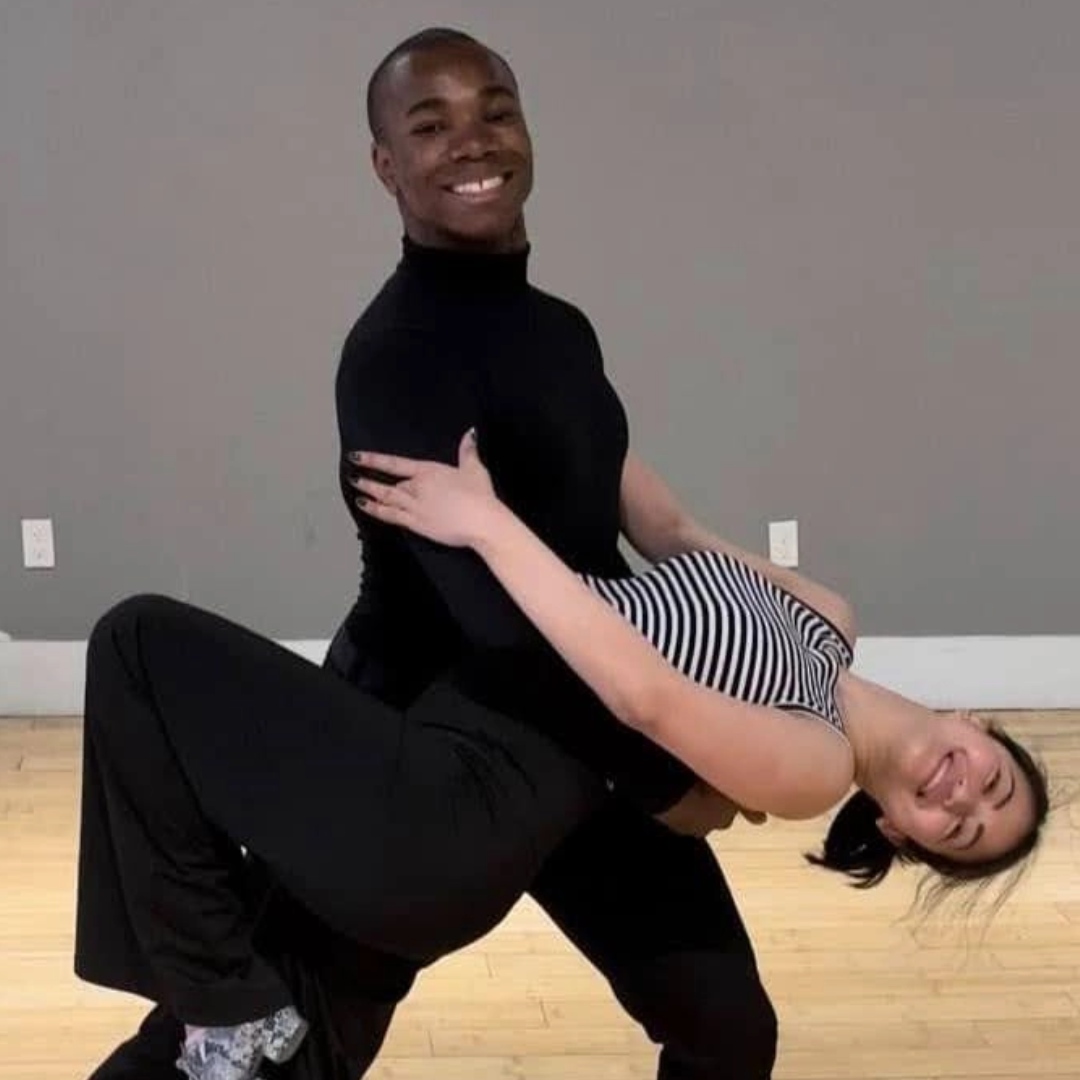
The main difference between Salsa and Bachata is that Salsa is fast and built around turns and spins. On the other hand, Bachata is slower, closer, and moves side to side with a signature hip motion. You’ll hear them played back to back at Latin nights, and yet they feel like two completely different dances.
We teach both at Concierge Ballroom, and this is one of the most common questions we get from people coming to our dance studio in Philadelphia.
Let’s take a look at what sets them apart, from the music to the footwork to how you move with a partner.
| Salsa | Bachata | |
| The origin | Cuba, grew up in New York | Dominican Republic |
| Tempo | Fast, about 160–220 BPM | Slower, about 110–140 BPM |
| The feel | Energetic and playful, lots of turns and spins | Smooth and close, with a relaxed hip sway |
| How you move | In a slot and faster changes of directions | On the spot with slower changes of directions |
| Connection | Hand to hand or closed frame | Hand to hand, closed frame, or close embrace |
| Beginner-Friendly | Medium, it takes a bit longer to feel natural | Yes, it’s a beginner-friendly style |
Where They Come From
Salsa grew out of Cuban dance music and took its modern shape in New York City in the mid-1900s, where Cuban, Puerto Rican, and other Latin communities mixed their styles together. That’s why “salsa” is really an umbrella term for a whole family of fast, percussion-driven music rather than one single thing.
Bachata started in the Dominican Republic and stayed a local, guitar-based style for decades before it spread around the world. That guitar is a big part of why it feels warmer and more laid-back. The roots tell you a lot: one carries the buzz of a big-city social scene, and the other carries the intimacy of the music it came from.
How to Tell Them Apart by Ear
The quickest giveaway is the instruments. Salsa has a repeating clave (the wooden “click” that anchors the rhythm), congas and timbales driving underneath, a piano, and bright horns on top. Bachata is cleaner and guitar-forward, built on five core instruments. The requinto (the lead guitar that seems to cry out the melody), the segunda (a rhythm guitar that strums the groove), the bass, the bongos, and the güira, a metal hand scraper that keeps a steady metallic tick going underneath.
The easiest tells: if you hear bright horns and a busy percussion layer, it’s Salsa; if you hear that metallic güira scrape and a crying lead guitar, it’s Bachata. Read more about why these two bring the energy to any party.
The Basic Step
Both dances fit six steps into an eight-count musical phrase: you step on counts 1, 2, 3, 5, 6, and 7. It’s what happens on counts 4 and 8 that sets them apart:
- Salsa: you hold on 4 and 8. The six steps move on the spot and around your partner, with turns, spins, and cross-body leads, when the leader guides the follower across to the other side.
- Bachata: instead of holding on 4 and 8, you add a tap, a light touch of the foot with a small hip pop.
Beginner tip: don’t force the hips.
The hip motion trips up new students more than anything else, and the harder you try to swing your hips on purpose, the stiffer you look.
Here’s what works: the movement isn’t something you do, it’s something that happens. When you bend the knee of the leg you just stepped onto and let your weight settle into it, the hip drops on its own. So focus on your feet and your weight, not your hips, and the rest will follow.
Salsa vs. Bachata for Beginners: Which Is Easier?
Not sure which to try first? A quick way to decide:
- Start with Bachata if you’re nervous, brand new to partner dancing, or you just want to feel good on the floor quickly.
- Start with Salsa if its energy is what pulled you toward Latin dancing, or you already have some rhythm and want a bigger challenge with more room to play.
So why is Bachata more beginner-friendly? It asks less of you at once. The timing is even and repetitive: three steps, then a tap on the fourth beat, no syncopation. You can find the beat from the very first song.
Salsa piles on more at the same time. The count is faster and syncopated, with steps on 1-2-3 and 5-6-7 and pauses on 4 and 8. Turns show up early, and turning left and turning right are separate patterns. On top of that, the lead runs through your hands, so there are constant hand changes and arm styling to manage.
Whichever one pulls you in, the best way to decide is simply to take a class, and here’s where to find adult dance classes in Philadelphia to get you started.
Can You Learn Salsa and Bachata at the Same Time?
Yes. They run on the same eight-count timing, so the rhythm you build in one carries straight into the other. The core partner skills are shared too: a steady frame, clean weight changes, and reading a lead all work the same way in both.
The only real catch is fitting both into your week, and the simplest fix is a class night where you can learn them both.
At our dance studio in Philadelphia, we have Latin Nights, where you can learn both styles:
- Intro to Salsa: 6:00 – 7:00 PM
- Salsa Level 1: 7:00 – 8:00 PM
- Bachata Level 1: 8:00 – 9:00 PM
No partner is needed.
Try Latin Dance Lessons in Philadelphia at Concierge Ballroom
Now you know what sets the two styles apart. The next step is feeling it for yourself.
Concierge Ballroom sits right in Center City Philadelphia, minutes from Independence Hall and easy to reach by SEPTA, PATCO, or car. You don’t need a partner, any experience, or a clue which style you’ll love. You just need to show up.
Want to find out whether you’re a Salsa or a Bachata person? Book your first dance lesson and come dance with us.